Connection, co-regulation, boundaries, and repair.
01 · LEARN
Curiosity
What are we discovering?
ATTACHMENT
Attachment is not a parenting grade.
Secure attachment is not created through one perfect response. It grows through repeated experiences of availability, responsiveness, safety, support, boundaries, and repair.
START HERE
Five short introductions
Begin with one resource, then return when you want to explore further.
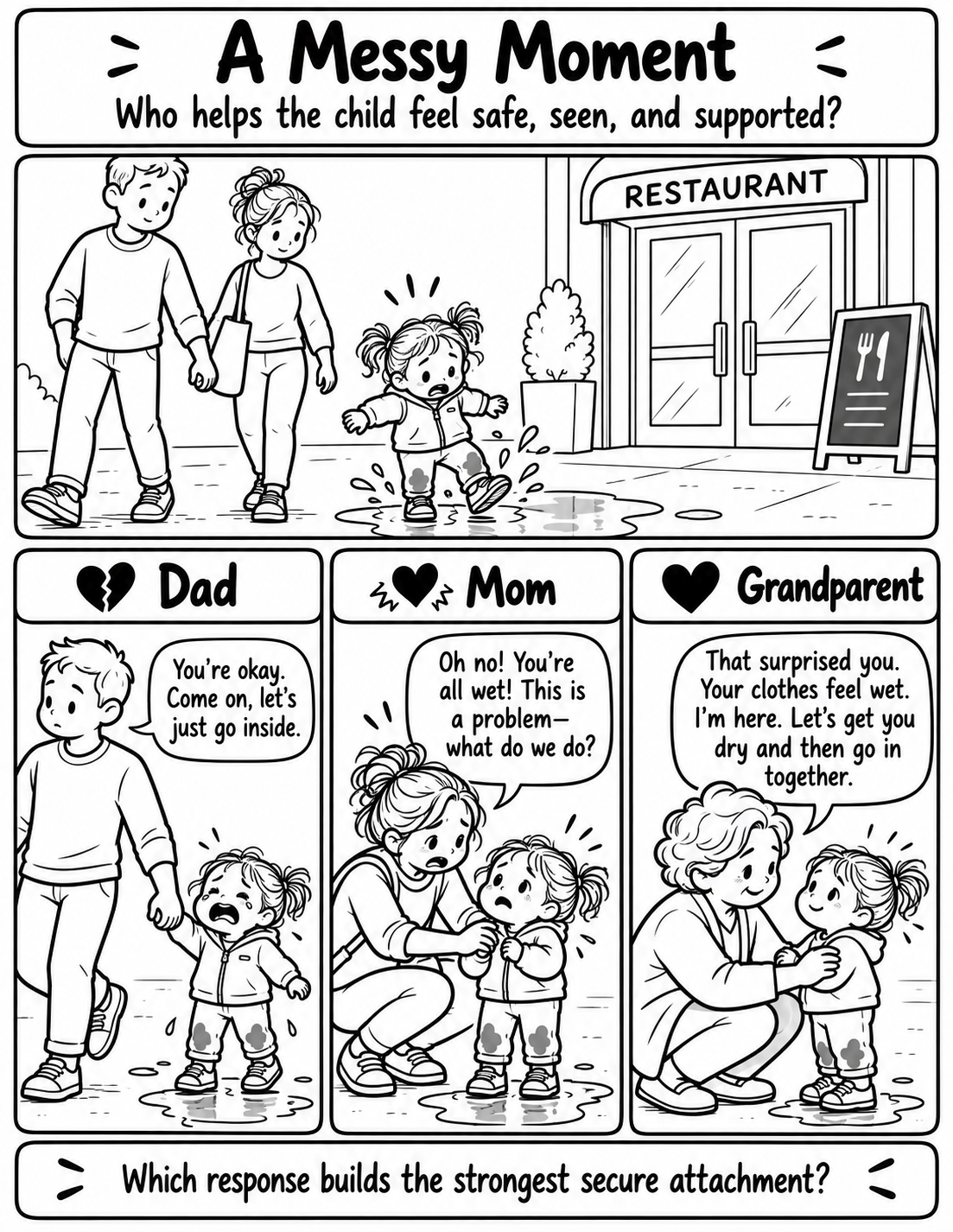
Look at the three caring responses. Which response helps the child feel safe, seen, and supported?
Use this prompt for reflection and discussion. It is not a tool for diagnosing attachment styles.
EVOLVE + LIFEPROOF TOOLS
Strong BASE. Prepare for RAIN. Learn to FLOW.
BASE is my relationship with my child. RAIN is my relationship with myself. FLOW is what we do together in the hard moment.
BASERelationship with my child
RAINRelationship with myself
FLOWWhat we do together
A strong BASE gives us somewhere to return. RAIN helps us understand what is happening inside us. FLOW helps us move through the hard moment together.
THE ATTACHMENT RELATIONSHIP
BASE
Branch Out → Attention → Support → Explore Again
B
Branch Out
The child explores through play, movement, ideas, friendships, risk-taking, independence, new behavior, and big feelings.
A
Attention
The child checks for connection, reassurance, recognition, or help. Behavior is communication, and sometimes attention-seeking is connection-seeking.
S
Support
We respond to what the child needs while staying connected and holding appropriate boundaries. Support may include comfort, co-regulation, scaffolding, guidance, protection, boundaries, and help making sense of the moment.
E
Explore Again
The child has enough safety and connection to re-engage with the world in whatever way comes next.
THE ADULT’S INNER PROCESS
RAIN
RAIN is the adult’s relationship with self. Adults sometimes feel “on fire” or “stuck in the mud.” A little RAIN can help us pause and choose our next move.
RRecognize
AAllow
IInvestigate
NNurture
THE PRACTICAL TOOL FOR THE HARD MOMENT
FLOW
FLOW is what we do together when a moment is hard.
F
Feelings
Notice and name the feeling first, when needed.
L
Link
Create connection before trying to move forward.
O
Options
Offer simple, empowering choices.
W
Win-Win
Find a solution that considers both sets of needs while the adult keeps necessary limits.
SEEN · HEARD · VALUED
Belonging remains.
Seen
You notice me and try to understand my inner world.
Heard
My communication matters — even when I do not yet have the words or skills to express it well.
Valued
My worth does not disappear when my behavior is hard.
Core ideas for this course
Connection does not equal permissiveness.
A child can be sad, angry, disappointed, or overwhelmed while an adult calmly keeps a necessary boundary.
Behavior is communication.
And sometimes, attention-seeking is connection-seeking.
Co-regulation supports self-regulation.
Warmth and structure belong together.
Repair matters.
Relationships do not require perfection. “That didn’t go how I wanted. Let’s try again.”
Belonging remains.
You can have a hard feeling. You can make a mistake. You can need a boundary. And you still belong.
Responsive parenting includes limits.
We can acknowledge the feeling, stay connected, and still lead.
The Brain Architects — Mattering in Early Childhood
A conversation about a need we care deeply about at Evolve: children knowing they matter. Being seen, heard, valued, and significant becomes part of how a child understands themselves and their place with others.
Circle of Security — What Is the Circle of Security?
One of the clearest ways to picture attachment: children move out to explore and come back for connection, comfort, reassurance, and help. A useful companion to BASE and a reminder that secure attachment supports independence rather than preventing it.
Circle of Security — Free Parent Resources + Downloads
A collection of parent-friendly videos and visual tools around secure-base behavior, caregiver reflection, “good enough” parenting, and the needs underneath children’s behavior.
A warm, practical look at something we see every day at Evolve: children develop through relationship. Talking, comforting, playing, noticing, and responding all help build trust, communication, confidence, and emotional growth.
A simple introduction to the back-and-forth interactions that help shape early development. Children reach out in small ways, and responsive adults answer.
Children’s Emotional Development Is Built into the Architecture of Their Brains
A deeper look at how early relationships and emotional experiences become part of a child’s developing foundation. Helpful science without turning childhood into a performance project.
Early Childhood Teacher-Child Attachment: A Brief Review of the Literature
One of the resources Evolve saved early in our work. It introduces the secure-base idea clearly: children need adults who are available, predictable, nurturing, and responsive so they can move out into the world and return when they need comfort or reassurance.
A systems-level resource that helped shape early Evolve thinking around safety, stability, nurturance, predictable routines, responsive adults, and the role of early childhood settings in supporting children through adversity.
An older attachment-oriented resource from our original Evolve research collection. Useful as historical context for how relationship, attunement, and the developing mind became central to our early philosophy.
It Takes a Village to Raise a Child: Understanding and Expanding the Concept of the “Village”
A research-based look at the many people and systems surrounding a child — family, neighbors, teachers, professionals, community, and policy. A useful reminder that attachment and resilience do not live only inside the parent-child pair.
A relationship-centered look at what children most need from caregivers: to feel safe, seen, soothed, and secure. Best used as an invitation to reflect, not another standard for doing parenting perfectly.
A deeply developmental look at young children through attachment, maturation, emotion, and play. Especially helpful when behavior makes more sense once we understand what is still growing underneath it.
A compassionate guide to the intense and contradictory inner world of ages one to three. It helps adults look beneath toddler behavior and better understand autonomy, attachment, emotion, and the child’s experience.
A whole-body way of looking beneath behavior. Instead of beginning with “How do I stop this?” it helps us notice nervous-system state, sensory experience, stress, safety, and what a child may actually be able to do in the moment.
An approachable guide for understanding developing brains and emotions, with practical ideas for connection and support. Best read as one useful lens rather than a rulebook for getting parenting “right.”
A hopeful introduction to rupture and repair. Strong relationships do not require perfect interactions; children can learn that disconnection can be followed by honesty, reconnection, and care.